The 8-Week 10K Training Plan
This plan has one entry requirement: you can run 3 miles today, at any pace, without stopping. If that's you, eight weeks is enough to get to a 10K start line properly trained — not surviving on adrenaline.
No vague "run some miles" weeks. Every day for 56 days is written out below: four runs a week, one optional cross-training day, two full rest days. Print it, stick it on the fridge, cross the days off.
Is this the right plan for you?
Eight weeks is the honest middle path: long enough to build real endurance, short enough that the finish line stays vivid. But it only works from the right starting point. You're in the right place if:
- ✓You can run 3 miles (5 km) without stopping — pace irrelevant. A 38-minute 5K counts exactly as much as a 24-minute one.
- ✓You can give it four runs a week. Around 3–4.5 hours total. Miss one run, drop the Sunday jog — never the long run.
- ✓You have a date. A race entry, or a self-set 10K day in week 8. Plans without a date have a way of becoming suggestions.
Starting from zero instead? Don't force this one — the couch-to-10K run/walk plan takes twelve weeks and assumes nothing at all.
Every day, written out
8-Week 10K Training Plan · runmatch.io/8-week-10k-training-plan
Swipe the table sideways — the week column stays put. →
| Week | Mon | Tue | Wed | Thu | Fri | Sat | Sun | Total |
|---|---|---|---|---|---|---|---|---|
| Phase 1 · Base — weeks 1–3 | ||||||||
| 1 | Rest | 3 mi easy | Cross-train 30 min or rest | 3 mi easy + 4×20s strides | Rest | 4 mi long easy effort | 2 mi jog | 12 mi |
| 2 | Rest | 3.5 mi easy | Cross-train 30 min | 3 mi middle 1.5 mi steady | Rest | 4.5 mi long | 2 mi jog | 13 mi |
| 3 | Rest | 4 mi 6×400 m @ 5K effort, 400 m jog between | Cross-train 30 min | 3.5 mi easy + 4 strides | Rest | 5 mi long | 2 mi jog | 14.5 mi |
| Phase 2 · Build — weeks 4–6 | ||||||||
| 4 | Rest | 4 mi 5×600 m @ 5K effort | Cross-train 35 min | 4 mi 2 mi tempo inside | Rest | 5.5 mi long | 2.5 mi jog | 16 mi |
| 5 | Rest | 4.5 mi 4×800 m @ 5K–10K effort | Cross-train 35 min | 4 mi 2.5 mi tempo inside | Rest | 6 mi long | 2.5 mi jog | 17 mi |
| 6 | Rest | 4.5 mi 5×800 m | Cross-train 40 min | 4.5 mi 3 mi tempo inside | Rest | 6.5 mi long | 3 mi jog | 18.5 mi |
| Phase 3 · Peak & race — weeks 7–8 | ||||||||
| 7 | Rest | 5 mi 6×800 m — the hardest day of the plan | Cross-train 40 min or rest | 4.5 mi 3 mi tempo inside | Rest | 7 mi long longest run of the plan | 3 mi jog | 19.5 mi |
| 8 | Rest | 3 mi 4×400 m, full recovery | Rest | 2 mi easy + 4 strides | Rest | RACE DAY — 10K | Walk. Stretch. Brag. | 5 mi + 10K |
Reading the workouts: "6×400 m @ 5K effort" means run 400 m at the pace you could race a 5K, jog 400 m, repeat six times — warm up a mile before, cool down a mile after (included in the day's total). "2 mi tempo inside" means the middle 2 miles of that run are at tempo effort. Strides are 20-second smooth accelerations, not sprints, with full recovery. Cross-training is anything with no impact: bike, swim, row, brisk hike.
The only four efforts you need
Notice the plan says "effort," not minutes-per-mile. Your paces will drift faster over eight weeks; effort scales automatically. Calibrate with the talk test:
Swipe sideways for the full table. →
| Effort | Talk test | Where it appears | The mistake to avoid |
|---|---|---|---|
| Easy | Full sentences, comfortably | Easy runs, long runs, Sunday jogs — most of your miles | Running these too fast. Easy means easy; it's where endurance is built. |
| Tempo | A few words at a time | Thursday runs, weeks 2–7 | Turning it into a race. "Comfortably hard" — you should finish wanting one more mile. |
| Interval | One word, maybe | Tuesday repeats (400s, 600s, 800s) | Sprinting the first rep. The sixth repeat should match the first. |
| Strides | n/a — 20 seconds | After easy runs, weeks 1, 3 and 8 | Treating them as sprints. Smooth and tall, like showing off for a camera. |
Three phases, one job each
Base — teach the legs to show up
Mileage climbs from 12 to 14.5 per week, almost all of it easy. The one spicy day (week 3's 400s) is short on purpose. The win here isn't fitness — it's the habit of four runs a week landing on schedule.
Build — make 6.2 miles feel short
Two quality days a week now: Tuesday repeats stretch to 800s while Thursday's tempo block grows from 2 to 3 miles — that tempo is your 10K race effort in rehearsal. The long run reaches 6.5 miles, past the point where race distance is scary.
Peak, then get out of the way
Week 7 is the biggest of the plan — 19.5 miles, capped by a 7-mile long run that makes race day a step down. Then week 8 cuts volume roughly in half. Taper feels like doing it wrong. It isn't; the fitness is banked, and rest is how you withdraw it.
Make it yours in 30 seconds
This page is one fixed plan: intermediate runner, 8 weeks, Saturday long runs. If your race is 6 or 10 weeks out, your long-run day is Sunday, or you're between fitness levels, the 10K plan generator rebuilds the whole schedule around your answers — same structure, your calendar.
The plan is free. Quitting is what costs you.
Here's what we've watched happen to eight-week plans: weeks 1–3 run on novelty. Then week 4 rains, week 5 has a work thing, and the plan quietly becomes a bookmark. The schedule above fails for one reason only — skipped Saturdays.
Never run before? This plan assumes you can already cover 2 miles — if you can't, start with the couch to 10K plan and come back here after.
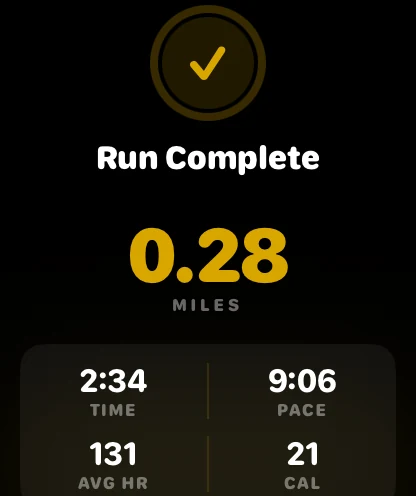
You put real money on your week — say $25 on completing your long run, every week of this plan. Runs verify automatically through your Apple Watch — GPS route plus heart rate; nobody's on the honor system. Finish, keep your money (and take your friends' if you raced them for a pot). Skip, and it goes to a recipient you chose in advance — your training partner, your sister, anyone whose smug texts you'd rather avoid. New runners get the reverse deal first: run one verified mile, we pay you $10. That's week 1, day 2 of this plan, already in profit. How the money moves is documented on the "is this legit" page — Stripe in, Stripe out, no points, no gift cards.
Two ways to hold yourself to eight weeks
Race your friends
Find someone running the same eight weeks. Same buy-in each; most miles or first to the distance takes the pot.
Bet on yourself
Stake your long runs, week by week. Miss one and the money goes to a recipient you chose — not to us, since RunMatch takes 0% of the pot.
- $21.14average one-day win
- $10median win
- $740biggest pot so far
Quick answers
Eight weeks is 32 runs. Make each one worth something.
Stake your long runs or race a training partner for a pot. Every run verified by GPS and heart rate on your Apple Watch.
Get RunMatch — run 1 mile, get $10- Payments via Stripe
- GPS + heart rate on Apple Watch
- Withdrawals via Stripe Connect
One $10 first-mile reward per new account · 18+ · iPhone and Apple Watch required · Terms apply