Race your friends
Everyone puts in the same amount and runs. Race, Most Miles or Streak — the winner takes the whole pot, and RunMatch keeps none of it.
Streaks and reminders stop working because nothing happens when you ignore them. This one moves money: stake your own cash on a run, and if you miss it, it goes to a person you named in advance. Not to us — RunMatch takes 0% of the pot.
iPhone + Apple Watch · free to download · 0% of the pot
That is the whole mechanism. No subscription gate, no points, no badges, nothing to redeem. The stake either stays yours or it doesn’t.
Every other app in this category sends a failed stake to the house, the pot, or both. We send it to someone you picked before you started, and we never touch it.
It matters more than it sounds. Money going to a faceless company is a fine, and people are strangely good at absorbing fines. Money going to your brother, who knows exactly what it was for and will mention it, is a different kind of pressure.
Released back to your balance the moment the run verifies on your Apple Watch. No fee, no cut, no charge for having used the app.
The person you named receives the stake. They find out you missed, because they are being paid to know. You are out $20 and a friend is up $20.
Compare that with the rest of the category. On StepBet a failed stake is absorbed into the pot and the house takes 15% of the whole thing before anyone is paid. On DietBet it is 10–25%. On HealthyWage there is no pot at all — the company keeps losing wagers outright and says so on its own site, describing forfeited bets as part of how it makes money.
We are not claiming to be more virtuous. We are claiming the money moves somewhere you can see, and that the destination is a person you picked rather than a balance sheet. That difference is also why it works better: a fine from a company is absorbable, and twenty dollars handed to your brother is not.
Solo stakes are one half of it. The other half is putting the same money in as a group and racing for it, which works on people who are more motivated by winning than by avoiding loss.
| Format | How it settles | Best for |
|---|---|---|
| Race | First person to hit a target distance takes the pot. | A group with similar paces and a competitive streak. |
| Most Miles | Highest total over a set window — usually a week. | Mixed abilities, because consistency beats speed. |
| Streak | Hit a modest daily target every day or you are out. Last one standing takes it. | The behaviour most people actually want: showing up. |
If you are choosing for a group that has never done this, pick Streak. Most Miles rewards whoever has the most spare time, and Race rewards whoever was already fastest. Streak rewards turning up, which is the habit you are actually trying to buy.
The median is the honest number and it is the one to plan around. A $10 median next to a $21.14 average tells you the distribution is skewed: most competitions are a few friends and a twenty, and a handful of large ones pull the mean up.
Nobody is funding a holiday with this. The point was never the winnings — it is that a $20 stake reliably gets a person out of the door on a Tuesday, and a free habit-tracking app reliably does not.
| App | Cut of the money at stake | Getting paid out | Where a failed stake goes |
|---|---|---|---|
| RunMatch (ours) | 0% of the pot | 3% when you withdraw | A person you named |
| StepBet | 15% of the gross pot | PayPal, no stated minimum | The pot and the house |
| DietBet | 10–25% of the pot | PayPal from points | The pot and the house |
| HealthyWage | No pot — algorithmic prize | Check ($7 fee) or PayPal | The company keeps it |
| Free habit apps | Nothing — nothing at stake | n/a | Nowhere. That is the problem. |
Ours in one line: free to download, free to race friends, 0% of the pot, and 3% only when you move winnings out. RunMatch Pro is $9.99 a month and unlocks exactly one thing — public matches against strangers. Racing people you know is free forever, and most people never pay us anything at all.
The wrong amount is the most common reason this fails, and it fails in both directions.
Too small and nothing happens. Five dollars is a rounding error; you will pay it and not think about it twice, and the stake becomes a subscription to feeling accountable rather than an actual consequence. Too large and something worse happens: you stop setting goals at all, because the downside is frightening, and an app you are afraid to open cannot help you.
The number you want is the one that makes you mildly annoyed to lose — big enough to argue with yourself about at 6pm, small enough that losing it is survivable.
Our own numbers back this up. The median win on the platform is $10 and the average is $21.14, which means most people have independently landed in that band without being told to.
A practical rule: start at $10 on a single run. If you hit it three times running and the stake never once crossed your mind, it is too low — raise it. If you catch yourself setting easier goals to protect the money, it is too high.
The pattern is consistent enough to set your watch by, and it is not a willpower problem.
A streak counter works while the streak is the reward. For the first fortnight the number going up is genuinely motivating. Then one day you miss, the counter resets to zero, and the thing that was motivating you has been deleted — so the second miss costs nothing at all. Most habit apps are at their weakest exactly when you need them most.
Reminders decay faster. A notification you have ignored four times is no longer a notification, it is wallpaper. Badges and rings have the same arc: novel, then routine, then invisible.
A stake does not decay, because it is not a feeling. Twenty dollars is worth the same in week nine as it was in week one, and it does not reset when you miss — it leaves.
There is a reason the asymmetry works. Behavioural economists have spent decades on the finding that losses feel heavier than equivalent gains: being handed $20 is pleasant, and having $20 taken is disproportionately unpleasant. Nearly every habit app is built on the pleasant half — earn a badge, extend a streak, fill a ring. A stake is built on the heavy half, which is why a smaller number moves you further.
The second mechanism is a commitment device: a decision made by today’s well-rested self that binds tomorrow’s tired one. You are not relying on being disciplined at 6pm on a wet Tuesday, because the discipline already happened on Sunday, when you set the stake and named a recipient. The idea long predates fitness apps; the app is just a convenient way to hold the money.
The third is an audience of one. Naming a person turns a private decision into a visible one. Skipping now has a witness who finds out automatically, which is the thing a solo streak counter can never supply no matter how big the number gets.
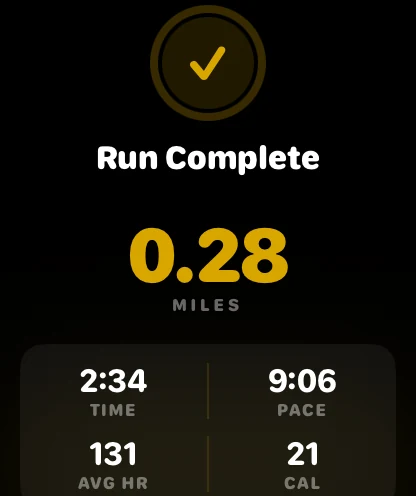
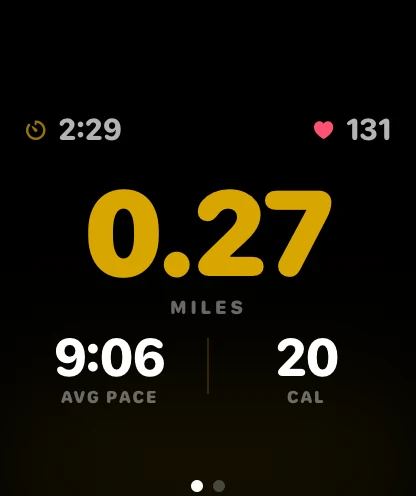
An iPhone and an Apple Watch. That is a hard requirement. A run submitted without Apple Watch heart-rate data is rejected by the server outright — the error is literally NO_WATCH_HR. That strictness is what makes it safe to hold your money: GPS alone can be faked by a spoofing app or produced honestly by a bicycle, but producing 150 bpm for forty minutes on the sofa is a different project.
It tracks runs, not workouts. The search term says “workout” and we would rather be straight with you: there is no gym tracking, no lifting, no classes, no Android, no Garmin and no Fitbit. If the thing you keep skipping is the gym, close this page. If it is the run, this is built for exactly that.
Apple Watch Series 4 or later, on watchOS 10, with the phone on iOS 17. Series 3 cannot run it at all.
Worth answering plainly, because it is the first thing people ask.
Gambling is staking money on an outcome you do not control. Here you choose the goal, you choose the amount, you do the running, and you keep every cent if you finish. There is no house edge to beat because there is no house in the transaction — RunMatch takes 0% of the pot, and a missed solo stake goes to a person you named rather than to us.
The closest honest description is a commitment contract: a device economists have studied for decades, where you make a future failure expensive on purpose, while your judgement is still good. The money is not the prize. It is the reason Tuesday happens.
Practicalities: 18+, funds held by Stripe, withdrawals in roughly 3–7 business days, and you can cancel a stake any time before its deadline.
Everyone puts in the same amount and runs. Race, Most Miles or Streak — the winner takes the whole pot, and RunMatch keeps none of it.
Stake your own money on your own goal. Hit it and nothing moves. Miss it and it goes to the person you named, never to us.
Free to download, free to race your friends, 0% of the pot. Run one verified mile and we’ll put $10 in your wallet.
Get RunMatch — run 1 mile, get $10One $10 first-mile reward per new account · 18+ · iPhone and Apple Watch required · Terms apply